Increasing Velocity and Calculating Gravity Potential
Energy- Investigating our Vision Depth in the Cosmos
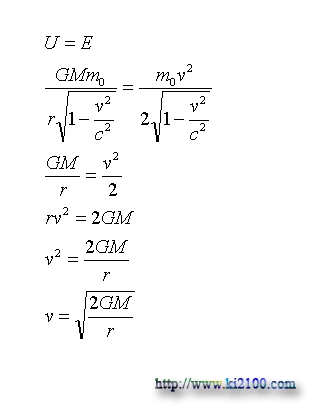
As we know escape velocity from surface of a celestial body is given
by following equation:
v
is escape velocity of the bullet, M is mass of heavy celestial body,
G is constant of gravity, and r is distance of center of heavy mass
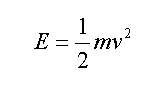
from center of the bullet. In classic physics, kinetic energy of a
bullet will be calculated by the following equation:
E
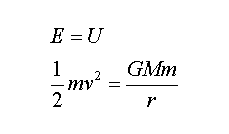
is kinetic energy and m is bullet mass. Now, we want to calculate
kinetic energy of the bullet in escape velocity:
U
is classic gravity potential energy. The gained result is classic
gravity potential energy, because the escape velocity is given by
the following equation:
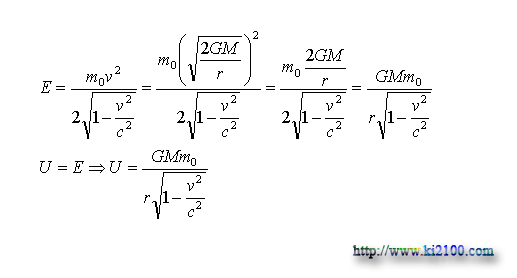
Now, we calculate relativity gravity potential energy of the bullet:
g
is gravitational acceleration, h is height or distance of gravity
field center and center of bullet, i.e. r, F is gravity force
between celestial body and bullet, m0 is station mass of bullet, c
is the light velocity, and r0 is primary distance of celestial body
and bullet. In other hand, we have:
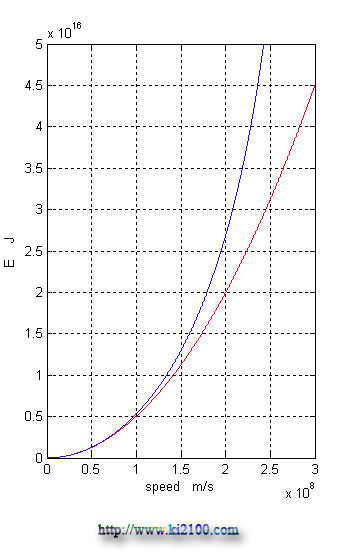
Comparison Diagrams of Classic Kinetic Energy and Relative Kinetic
Energy
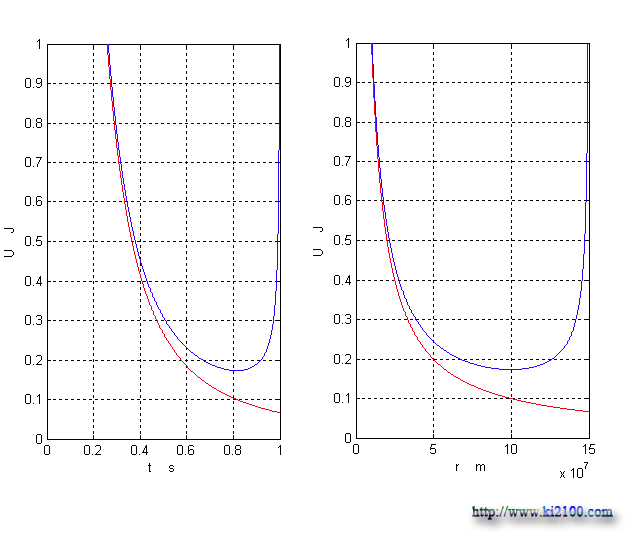
The red curve indicates increasing of classic kinetic energy and the
blue curve indicates increasing of relativity kinetic energy of the
bullet. In order to calculate escape velocity, by comparison
relativity kinetic energy and relativity potential energy of the
bullet, we have:
There is gained the same previous result in classic physics. So,
this equation is validated in relativity (high velocities). Now we
draw and comparison diagrams of classic gravity potential energy and
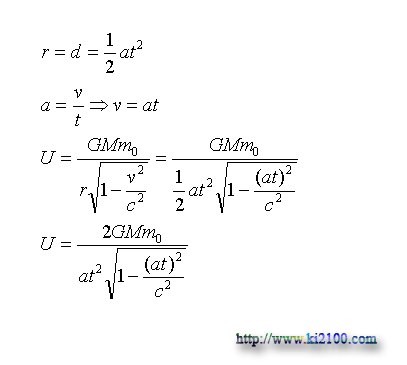
relativity gravity potential energy. We consider the motion as
accelerated motion and its acceleration is supposed as c in square
of second, i.e. by supposing a=c, we have:
d
is covered distance, and a is acceleration.
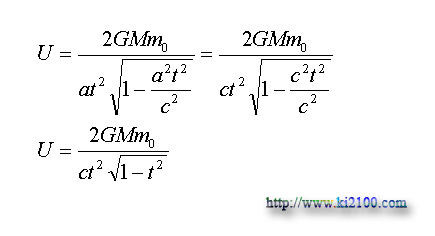
By
considering to this matter that the surface of above equation is
always a constant numerical, in comparison with time, velocity and
acceleration of bullet, by displacing
instead
GMm0, we can draw curves.
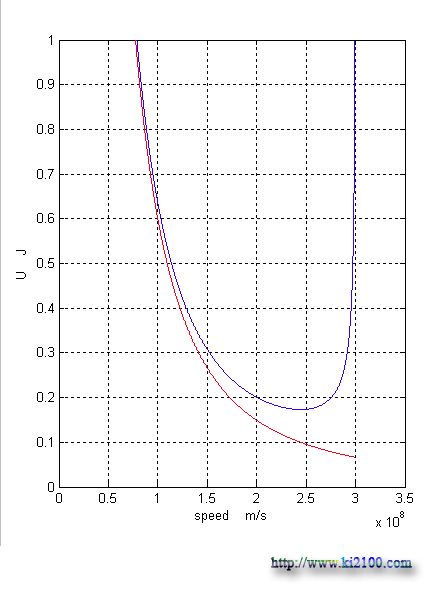
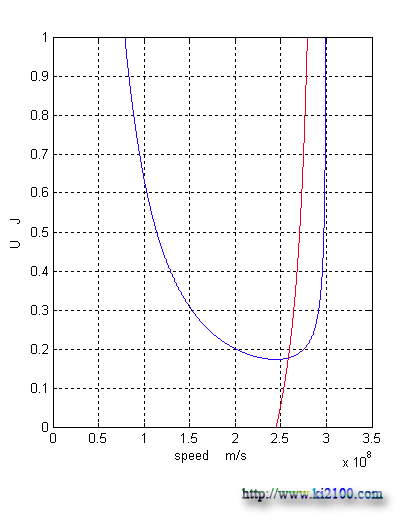
The red curve is related to classic gravity potential energy of
bullet, but the blue curve indicates its relativity gravity
potential energy. It is clear that relativity gravity potential
energy is decreased to 250.000 Km/s, but it is increased after that.
Now, we draw diagrams according to time and distance:
As
you see in the above diagrams, diagrams of relativity gravity
potential energy have a minimum quantity comparison with time,
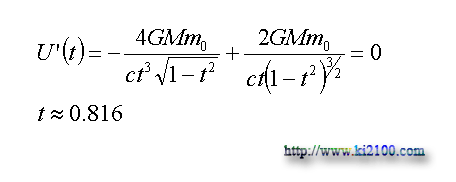
velocity, and distance. In order to find this quantity, we must
calculate differential of resulted equation or function for
relativity gravity potential energy according to t, and consider it
as zero and then calculate t:
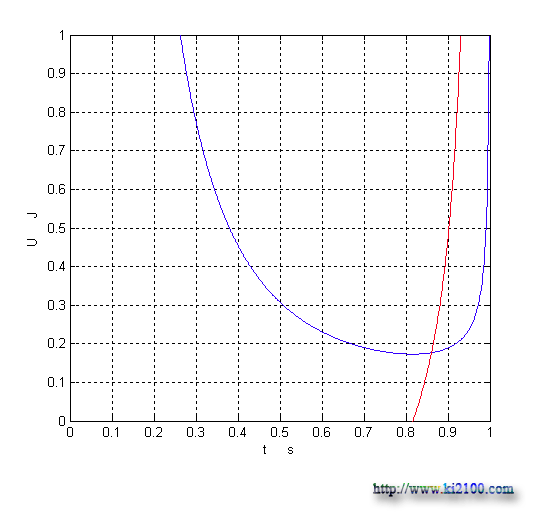
This quantity has been gained for t approximately and by drawing
differential diagram (the following red curve):
And for this velocity, we certainly have:
That it is gained 245,000 Km/s. By considering to these matters, we
can calculate our depth vision in cosmos.
Our
depth vision in cosmos:
As
we said previously, Big Bang Theory is an impossible theory. Now, if
we suppose that energy and particles could exit and escape from
primary hot corpuscle, acceleration of the cosmos expansion could
not be more than 1,
and resulted equation about relativity gravity potential energy in
this topic will be governed. As you can see in the above diagrams,
relativity gravity potential energy of escaped masses with
acceleration in
velocity 245,000 Km/s is a minimum quantity, but it will be
increased after that; it seems that increasing velocity will be
stopped in this point and therefore, velocity is constant and
acceleration will be zero, because in order to increase velocity, we
need a huge kinetic energy, which its providing source is unknown
yet. As we know observations of Hobble, a physicist, showed that
galaxies are being far from us by v velocity, which it is resulted
by the following equation:
V=HX
H
is Hobbles constant, and X is distance from the Earth. In fact, this
equation can be used for any point of the universe. In briefly,
velocity will be increased about 21,77 Km/s, instead of each one
million light year distance from us. The farthest distance of
celestial bodies from us is estimated 12 billion light years, i.e.
sent ultra-depth picture by mapping camera of Hobble, NASA. Now, by
considering to the above - mentioned matters, we can calculate our
depth vision in cosmos. For this, we divide escape velocity 245,000
Km/s (the maximum current escape velocity in the cosmos, resulted
from Big Bang theory and relativity theory) on 21,77 Km/s, which we
get 11.254 billion light year, and it is supposed that there isn't
anything upper than this permitted velocity or distance! But in
future, if celestial bodies will be observed beyond our current
depth vision, which they have certainly more distance and velocity,
Big Bang Theory will be cancelled in explanation of the cosmos
extension spontaneously.